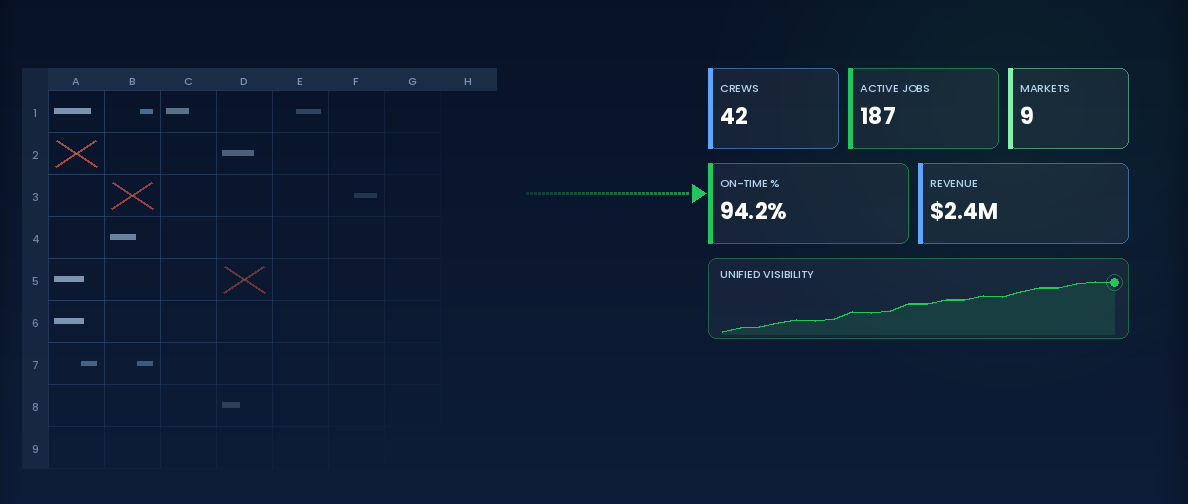
Beyond Spreadsheets: Why Your Telecom Operation Has Outgrown Excel
If your telecom or broadband operation still runs on a stack of spreadsheets — one for crews, one for inventory, another for billing, a fourth for HR — you are not alone. But you are at risk.
Spreadsheets feel cheap. They feel familiar. And in the early days of every contracting business, they get the job done. The problem is they don’t scale. The moment you add a second crew, a third market, or your fiftieth subcontractor, those tidy little tabs become the single biggest threat to your margins.
If you’ve felt that pressure lately, this is for you.
The Spreadsheet Tax: What It’s Actually Costing You
Every contractor we talk to underestimates the same number — the time their back office spends moving data between spreadsheets. The most common range we see is 12 to 20 hours per week per back-office employee. Multiply that across an ops team of five and you’re funding a full-time job that produces zero billable hours.
Here’s where the time goes:
• Re-keying field data that came in on paper, photos, or text messages
• Reconciling job costs between dispatch, payroll, and invoicing tabs
• Chasing subcontractor documentation at month-end because it never showed up the first time
• Updating inventory counts that were already wrong by the time they got typed in
That isn’t a staffing problem. It’s a systems problem. And spreadsheets are the system.
The Bigger Risk: You Can’t See Until It’s Too Late
The financial cost of spreadsheets is real, but it isn’t the worst part. The worst part is the blindness.
Spreadsheets are static. They show you what happened — usually a week or two after it happened. They don’t tell you that a crew is over-consuming materials right now, that a job is about to blow its labor budget today, or that a customer escalation is brewing because the foreman’s phone went to voicemail this morning.
By the time the spreadsheet says something is wrong, the margin is already gone.
What an ERP Built for Telecom Looks Like Instead
PenguinData was built for the operational reality that spreadsheets ignore. It’s not a generic ERP that was retrofitted for telecom. It’s a workforce management platform designed by people who ran broadband contracting businesses — and got tired of losing money to manual processes.
Here’s what changes when you make the switch:
• One source of truth. Crews, projects, materials, payroll, invoicing, and fleet all live in the same system, updated in real time.
• Field-first data capture. Crews log work on mobile devices. The data lands clean. Nobody re-keys anything.
• Live visibility for leadership. Every active job, every market, every crew — viewable from one dashboard.
• Audit-ready every day. Every transaction is timestamped, user-tagged, and tied to a job, work order, or client.
You Don’t Need a 6-Month Implementation
The biggest reason contractors stay on spreadsheets isn’t because they love them. It’s because they think the alternative is worse — a six-month implementation, a new IT department, and three weeks of crew training before anyone can do their job.
That’s not how PenguinData works. Most of our clients are fully onboarded in days, not months. The platform is built for operations teams that don’t have time to stop running jobs while they switch software.
Make the Move Before the Next Growth Cycle
The contractors who win the next wave of broadband expansion — BEAD, MDU buildouts, fiber-to-the-tower — are not the ones with the cleanest spreadsheets. They’re the ones who already moved past spreadsheets entirely.
If you’re feeling the squeeze right now, that’s the signal. Don’t wait for the next big contract to expose what your systems can’t handle.
Ready to see what your operation looks like without the spreadsheet tax? Book a free 30-minute demo and we’ll walk you through the platform — no commitment, no sales pressure. Just 30 minutes to see if it fits.